 (WOMENSENEWS)–
Context is everything. Well established by 1972, a mass movement of women was prying open the gates to every institution of U.S. life, from law schools and medical schools to "nontraditional" jobs and corporate hierarchies. No surprise, then, that religious institutions felt the pressure to make room for women in previously all-male positions of leadership. Relying on tradition and biblical authority, most churches and synagogues had successfully resisted the gender infiltration, but women had been arguing for ordination as ministers or rabbis since the late 19th century.
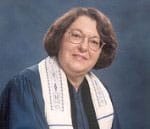
Sally J. Priesand always insisted that she was not interested in being a pioneer; she simply wanted to be a rabbi. The Hebrew Union College-Jewish Institute of Religion program had reluctantly admitted her to study at its Cincinnati campus and in 1972, the Cleveland woman who had been an English major in college was ordained as a rabbi. Her first job was in New York City at the Stephen Wise Free Synagogue, a historically progressive Reform congregation whose founder had pressured Franklin Roosevelt to do more to save Jews during the Holocaust and whose leadership in the 1970s was in the vanguard of protest against the Vietnam War.
But there was a glass ceiling in religious life as well as in secular life. As assistant rabbi, Priesand lasted seven years, during which other religious institutions began to ordain women. Recognizing that she would not be promoted to succeed the ailing senior rabbi at Steven Wise, she left. Unable to find a full-time position, she worked as a hospital chaplain and other part-time positions until she found a Reform temple in New Jersey, where she remained for 25 years.
As more women enrolled to study for the rabbinate, they found barriers were as deep-rooted there as elsewhere: As one student said at the time, "With the same breath that liberal Jews praise women rabbinical students, they ask the women to serve the coffee and cake."
Still, as women were ordained and found spiritual homes, mostly in Reform synagogues, they brought feminist ideas to Judaism, reinterpreting ancient rituals and shifting the rabbi’s role from absolute authority to something more like a partnership with congregants. By 2006, there were 829 female rabbis in the United States.
Rabbi Priesand’s work has expanded since to include writing a book, "Judaism and The New Woman," working with the homeless, with Planned Parenthood, in Holocaust studies and as a visual artist. Last year, she retired, surrounded by well-wishers and showered with awards.
Louise Bernikow is the author of seven books and numerous magazine articles. She travels to campuses and community groups with a lecture and slide show about activism called "The Shoulders We Stand On: Women as Agents of Change." She can be reached at louise@womensenews.org.
This story is sixth in a series on women changing religious institutions and practices and is supported by The Sister Fund.
For more information:
Lilith, "Ordained: Women Rabbis Speak Their Minds"
:
http://www.lilith.org/pdfs/LilithWinter2006_Rabbis.pdf
Stephen Wise Free Synagogue:
http://www.swfs.org/
Note: Women’s eNews is not responsible for the content of external Internet sites and the contents of Web pages we link to may change without notice.