
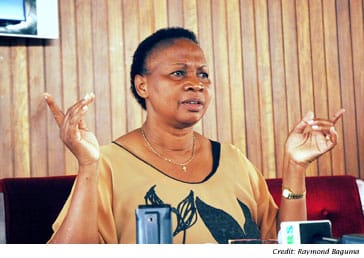
 KAMPALA, Uganda (WOMENSENEWS)–After parliament’s recent passage of key laws to protect women here, Jane Alisemera Babiha, chair of the Uganda Women Parliamentarians Association, is hoping a bill to modernize laws on marriage and divorce will sail through in January.
"We are anxious to have this law passed by the beginning of next year," Alisemera told Women’s eNews recently.
"It is only natural that as women, we should champion for the cause of our fellow women who we represent," added parliamentarian Mary Karooro Okurut, representative of the Bushenyi district. "But in our campaign, we are also enlisting the support of men."
The proposed law grants women the right to divorce spouses for cruelty and impotence. It also gives women the right to consent to marriage, often overlooked in African traditional weddings arranged by family and clan elders.
The bill also prohibits the customary practice of widow inheritance. In some Ugandan communities, widows are inherited by their brothers-in-law even when they do not consent to the marriage. The law gives widows the right to remarry people of their choice.
Sex without consent in marriage is prohibited by the bill, and there are incentives in the law to promote co-ownership of property between spouses. It also establishes a female-friendly protocol in the event of divorce: equal division of property and finances.
Alisemera said she expects the bill to win similar support in the 30-percent female parliament as the domestic violence bill, which passed in November and classifies domestic violence as a distinct crime, separate from other forms of physical assault.
Under that bill, now waiting approval by President Yoweri Museveni, alleged batterers face prosecutions in the formal Family and Children Courts, as well as the lowest-ranked Local Council Courts found in even the remotest of Ugandan villages. Convicted men or women would face punishments that include community service, reconciliation, compensation, fines or a two-year jail term.
60 Percent Suffer Violence
Sixty percent of women suffer physical violence at the hands of their intimate partners. Thirty percent have been victims of sexual violence and 16 percent reported physical violence during their pregnancies, according to the 2006 Uganda Demographic and Health Survey.
On Dec. 10, women’s rights activists here won another victory when a bill prohibiting female genital mutilation, or FGM, flew unopposed through parliament.
Female genital mutilation is traditionally practiced by the Sabiny and Karamojong communities living in Eastern Uganda. The bill targets the aggravated form of the mutilation, defining it as causing death, serious disability or an HIV-AIDS infection. Under the legislation, perpetrators of aggravated mutilation are liable for life imprisonment. Those who participate or aid the process of female genital mutilation in any form are liable for five years in jail under the bill. That bill is also on the president’s desk.
The anti-FGM law was sponsored by Dr. Chris Baryomunsi, the Kinkizi East member of parliament. Baryomunsi said he is positive that the president will sign it along with the bill on domestic violence.
"The president has been an active player in the national campaign to end female genital mutilation," Baryomunsi said. "According to procedure, the president should sign the bills within 30 days after receiving them. We are hopeful he will sign by the end of January."
The divorce and marriage bills have a long stop-and-start history here.
Elis Rubafunya, a legal analyst, wrote recently in Uganda’s leading newspaper, New Vision, that the bill is largely an amendment of family laws inherited from Britain, Uganda’s former colonial occupier.
Outdated Laws Remain
Since 1964, shortly after independence, lawmakers’ efforts to reform these laws largely failed, leaving matters bound to outdated British colonial laws, which in the case of adultery, for instance, punished a woman with 10 years in jail but let the man go free.
(In 2007 the Constitutional Court scrapped the adultery section in the old Divorce Act, ruling it unconstitutional and sexist.)
During the mid-1990s, the ruling political party in Uganda, the National Resistance Movement, sponsored family law amendments to other bills to modernize laws on marriage, divorce, separation and property.
Museveni refused to support the legislation, since it only recognized monogamous marriages and Uganda’s Muslims, about 12 percent of the population, wanted the right to polygamy recognized.
The current bills, which modernize all laws relating to marriage and divorce, languished until September this year when the Uganda Law Reform Commission introduced the new act to legislators during a seminar.
The proposed law will only govern Christian, Hindu, African customary and Baha’i marriages. A separate law for Muslim marriages will come later.
The current bill does not outlaw the traditional practice of the husband’s family giving marriage gifts to the wife’s family, the so-called bride price. Some women’s advocates oppose the bride price because it can inhibit abused woman from leaving their husbands for fear that they could demand refund of the gifts.
In the proposed legislation, bride price will not be returnable in the event of divorce.
Efforts to modernize marriage and divorce laws were spurred by a high-profile 2003 divorce case involving the country’s first female vice president, Dr. Specioza Wandira, who accused her husband, an engineer, of physical abuse. The country’s Catholic leaders intervened in a bid to reconcile the couple, but they separated.
"Dr. Specioza reflected what goes on in our communities," said Alisemera. "If a woman of her social status and education is battered, then what would happen to a woman in the village?"
Raymond Baguma is a staff reporter for The New Vision newspaper in Uganda. He also has a blog: http://www.rbaguma.blogspot.com.